Selected Engineering Insight
Optimizing Embedded Linux for Real-Time Performance
Real-time behavior on an embedded Linux platform is a system property. Kernel configuration, scheduling, interrupts, drivers, memory activity and application design all contribute to the latency and jitter seen at the final interface.
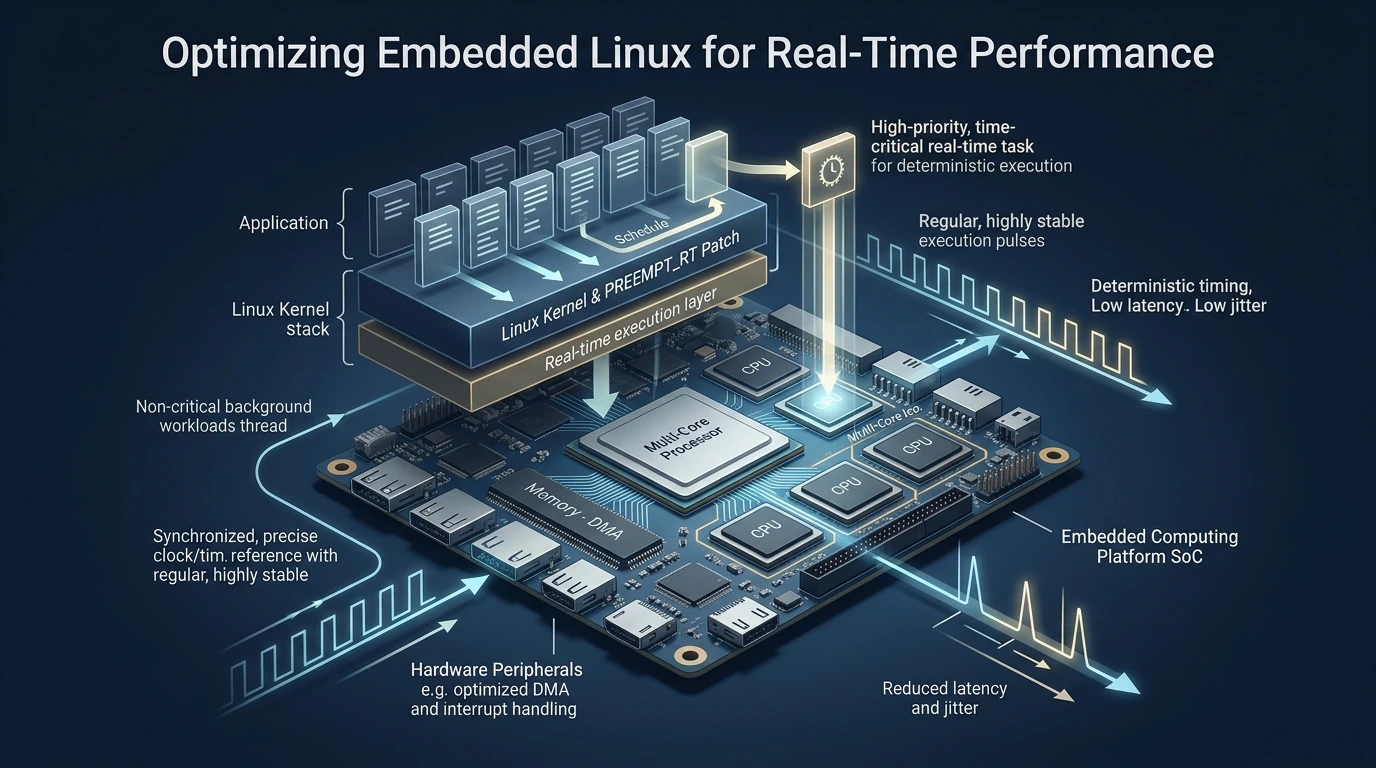
The Engineering Problem
Determinism is more than a fast CPU
A system can have plenty of processing headroom and still miss a timing requirement because work is interrupted, queued or delayed by another subsystem. Real-time optimization therefore starts with measurement: define the deadline, identify the timing path and observe the system under realistic load.
-
Scheduling
Choose priorities and scheduling behavior deliberately around the actual timing requirements. -
Interrupts
Understand interrupt affinity, service time and interference between high-rate devices and application work. -
Kernel behavior
Use an appropriate real-time configuration and verify its effect rather than assuming a configuration change guarantees determinism. -
Application design
Reduce unnecessary blocking, uncontrolled allocation and unpredictable work in time-critical paths.
Practical Design
Optimize the whole timing path
The useful measurement is usually end-to-end. A timestamp taken inside one process can look excellent while device buffering, driver behavior or downstream processing adds substantial delay. Instrument the boundaries that matter to the system and compare latency distributions, not just average values.
For embedded platforms that combine Linux with FPGA or dedicated hardware, the hardware/software interface deserves particular attention. Moving a task into hardware does not automatically make the system deterministic if synchronization, DMA, buffering or user-space handling remains uncontrolled.
Related ETROYL Capability
Embedded software connected to real hardware
ETROYL works across embedded Linux, FPGA, video and signal-processing platforms, with system behavior considered from hardware interfaces through software and deployment.