Selected Engineering Insight
Fast Near-Field Modeling for GPR Systems
Ground-penetrating radar sits at the intersection of electromagnetics, antennas, signal processing and uncertain subsurface conditions. Useful modeling must respect that physics while remaining practical enough to support engineering decisions.
The Modeling Challenge
Physical fidelity versus computational cost
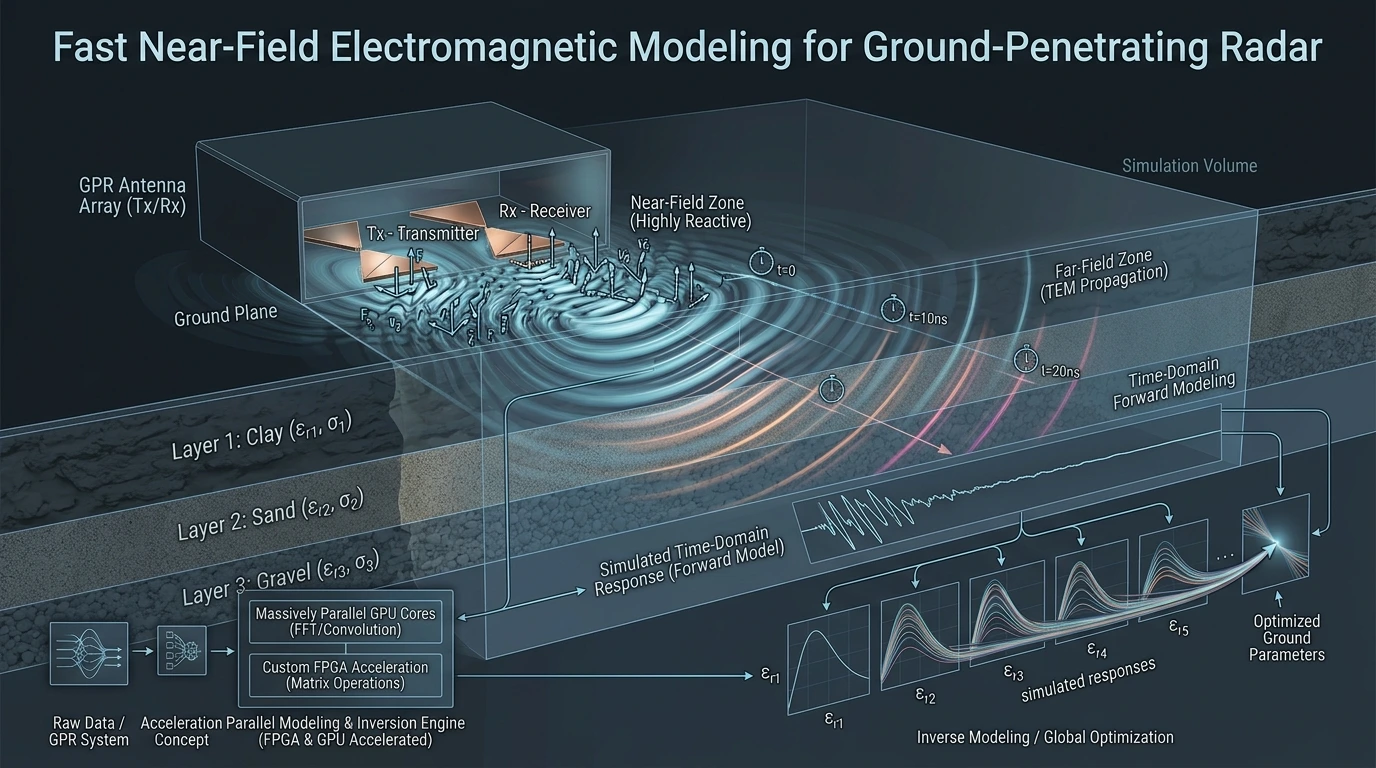
Near-field GPR problems are difficult because the antenna, ground interface, subsurface structure and measurement geometry interact. A model that is too simplified can hide the effects that matter; a model that is unnecessarily expensive can become disconnected from practical design and interpretation workflows.
-
Near-field behavior
The antenna and its immediate electromagnetic environment cannot simply be treated as a distant-field source. -
Material uncertainty
Permittivity, conductivity and geometry vary in real ground, so modeling assumptions must remain explicit. -
Geometry matters
Transmitter, receiver, antenna orientation and target position can strongly affect the observed response. -
Useful computationThe best model is not necessarily the most detailed one; it is the one that preserves the physics needed for the engineering question.
ETROYL Perspective
Build the model around the question
A practical modeling workflow starts by identifying which physical effects must be retained and which can be represented more efficiently. That creates a path toward reduced computational cost without pretending that the underlying electromagnetic problem has disappeared.
For GPR, this distinction is particularly valuable when modeling is connected to measurement, signal processing or inverse interpretation. A model becomes engineering infrastructure when its outputs can be compared with real data and used to guide the next design or measurement decision.
Related ETROYL Capability
From electromagnetics to sensing systems
ETROYL combines near-field electromagnetic modeling with GPR system engineering, radar signal processing and practical sensing workflows.