Featured Project · Embedded Systems · Computer Vision
Embedded Vision System
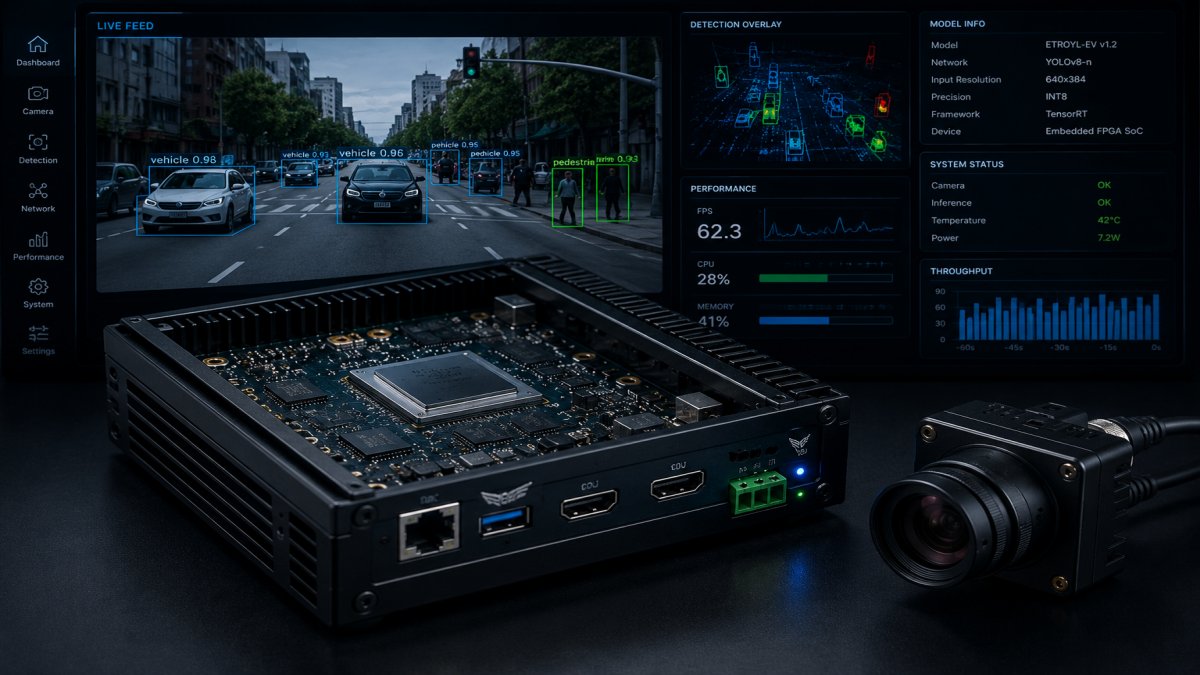
A potential low-latency embedded vision architecture combining real-time video processing, hardware acceleration and neural-network inference for detection, recognition and identification applications.
The Engineering Challenge
Processing video fast enough to make decisions in time
Embedded vision systems must move high-bandwidth image data through acquisition, preprocessing, inference and output while operating within strict limits on latency, memory, power and compute resources. A solution that performs well in isolation can still fail when the complete pipeline introduces avoidable delays.
ETROYL's engineering approach treats the video path as an integrated hardware/software system. The architecture can consider image transport, buffering, pixel processing, accelerator interfaces, neural-network execution and embedded control as parts of one performance problem.
Pipeline Architecture
A deterministic path from sensor data to inference
-
Real-time video transport
Move image streams through the system while maintaining the required rate, format and timing relationships. -
FPGA acceleration
Use parallel hardware processing for suitable image-processing stages and data transformations where deterministic execution is valuable. -
Neural-network inference
Integrate inference into the video pipeline while accounting for tensor preparation, memory movement and accelerator scheduling. -
Low-latency system integration
Measure the complete path rather than optimizing individual processing blocks without considering their interaction.
Engineering Method
Latency, throughput and accuracy must be considered together
Vision performance is a system-level trade-off. Increasing model complexity may improve recognition accuracy while increasing compute and memory requirements. More buffering may simplify rate matching while increasing end-to-end latency. Moving a processing stage into hardware may improve throughput while consuming valuable FPGA resources.
The practical objective is therefore not simply maximum inference speed. It is a balanced architecture in which image quality, model behavior, processing throughput, latency and resource usage meet the requirements of the intended system.
Project Scope
Connecting computer vision to the embedded platform
Deployable vision systems often require expertise across digital design, embedded software, video interfaces and system integration. Keeping these disciplines connected makes it possible to identify bottlenecks at their real source and investigate architectures that could meet the requirements of a future deployment.
This project represents a potential product direction for ETROYL. The underlying engineering capabilities can be brought together to develop application-specific embedded vision systems rather than implying that a finished ETROYL platform is already commercially deployed.
Building a vision system for the real world?
Let's discuss the video architecture, inference requirements and engineering constraints behind your application.
Get in Touch