Featured Project · Radar & GPR · Electromagnetics
Ground Penetrating Radar (GPR)
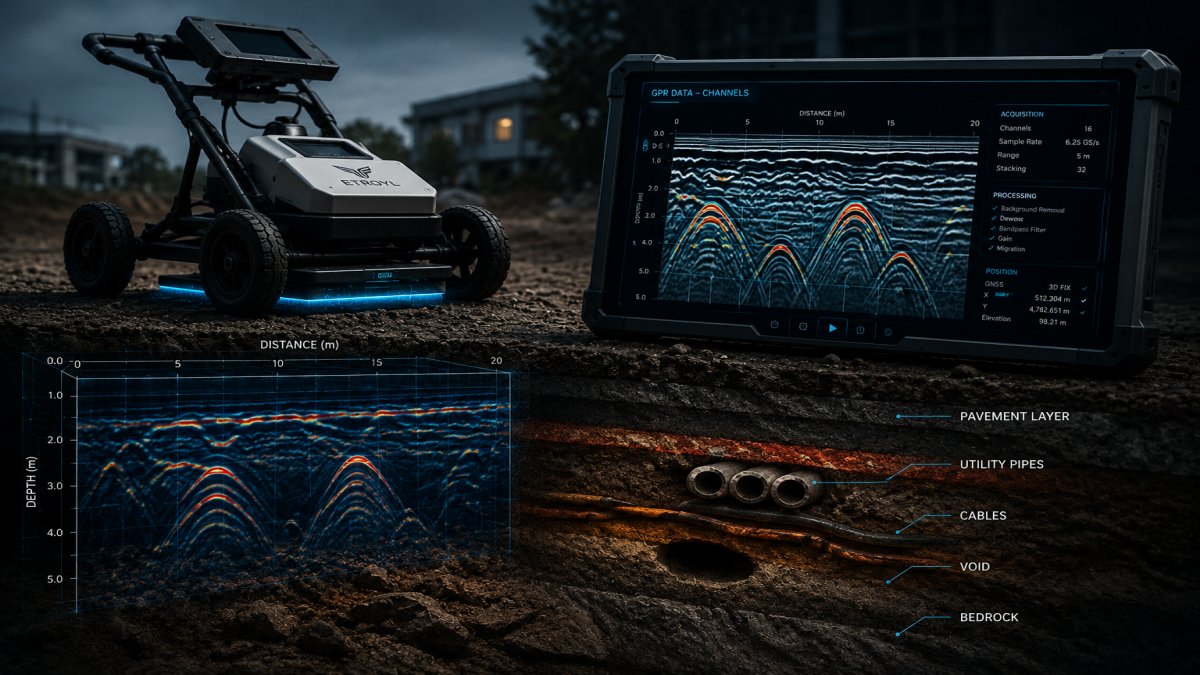
ETROYL is developing its own time-domain GPR system, combining advanced antenna design, deep-scan optimization, high-performance data and signal processing, and practical near-field electromagnetic modeling for accurate medium characterization.
The Engineering Challenge
Designing the complete GPR chain around depth, resolution and physical understanding
Ground-penetrating radar is fundamentally an electromagnetic sensing problem. The transmitted field interacts with the antenna environment, soil structure, buried interfaces and targets before the resulting signal returns to the receiver. Practical performance therefore depends on the complete chain, from antenna and acquisition through signal processing and interpretation.
ETROYL's objective is to develop a time-domain GPR system in which these elements are designed together rather than treated as independent components. Particular attention is given to antenna behavior, usable depth, signal integrity, computational efficiency and the ability to characterize the medium through physically informed modeling.
System Development
From antenna design to advanced data interpretation
-
Advanced antenna design
Develop antenna concepts with attention to bandwidth, coupling, radiation behavior, impedance and interaction with the surrounding ground, with the aim of maximizing useful subsurface penetration. -
Depth-oriented time-domain acquisition
Engineer the transmit, receive and acquisition chain around the practical objective of extracting useful information from greater depths while preserving signal quality and timing integrity. -
High-performance data and signal processing
Apply advanced processing techniques to improve the extraction, representation and interpretation of subsurface information, with a path toward accelerated FPGA/GPU implementations where appropriate. -
Practical near-field GPR modeling
Develop computationally efficient near-field electromagnetic models that can be used in practical engineering workflows rather than remaining purely theoretical simulation exercises. -
Medium characterization
Connect measured radar responses with electromagnetic properties of the surrounding medium to support more accurate interpretation and characterization of subsurface conditions.
Modeling & Validation
Making electromagnetic modeling practical for GPR development
Near-field electromagnetic modeling is particularly valuable in GPR because the antenna, ground and target cannot always be treated as separate or weakly coupled elements. ETROYL's approach is to develop models that retain the relevant electromagnetic physics while remaining sufficiently efficient to support practical system development and analysis.
The modeling can guide antenna development, investigate propagation and coupling effects, study expected responses for different media, and help interpret measured data. Validation against measurements then provides a route to refine both the physical model and the processing methods.
ETROYL GPR Direction
Developing a GPR system around the physics of the measurement
ETROYL is developing its own time-domain GPR system as a potential product, bringing together expertise in antennas, electromagnetics, radar signal processing, numerical modeling and embedded digital systems.
The intended system is not simply a radar front end followed by generic data processing. The development direction is to integrate advanced antenna design, depth-oriented sensing, high-performance signal processing and practical near-field modeling into a coherent system capable of extracting and characterizing subsurface information with a strong physical basis.
This is an active product-development direction rather than a claim of an already deployed commercial ETROYL GPR system. The objective is to turn the underlying scientific and engineering capability into a complete ETROYL product.
Exploring advanced GPR technology?
Let's discuss the electromagnetic, antenna, signal-processing and system-level challenges behind your sensing application.
Get in Touch